The Pros, Cons, and Advantages of Both Techniques
Central Oregon is home to some of the best kokanee fishing in the Pacific Northwest. From Paulina Lake and Odell Lake to Wickiup Reservoir, Crane Prairie, Crescent Lake, and Lake Billy Chinook, anglers have countless opportunities to target aggressive, hard-fighting kokanee throughout the season.
When it comes to trolling for kokanee on Central Oregon lakes, two techniques consistently stand out above the rest: long line fishing and downrigger fishing. Both methods are extremely effective, and each has advantages depending on fish behavior, water temperature, season, and lake conditions.
At Baddfish Guide Service, we use both techniques regularly throughout the season because understanding when to use each one can make a huge difference in success on the water.
Let’s break down the pros and cons of long lining versus downrigger fishing and explain why both methods are valuable tools for kokanee anglers.
What Is Long Line Fishing?
Long line fishing is trolling without the use of downriggers. Instead, anglers run their tackle directly behind the boat using flat lines, inline sinker weights, snap weights, or leaded line to achieve the desired depth.
This method is especially effective when kokanee are suspended high in the water column during spring and early summer.
Typical long line kokanee setups often include:
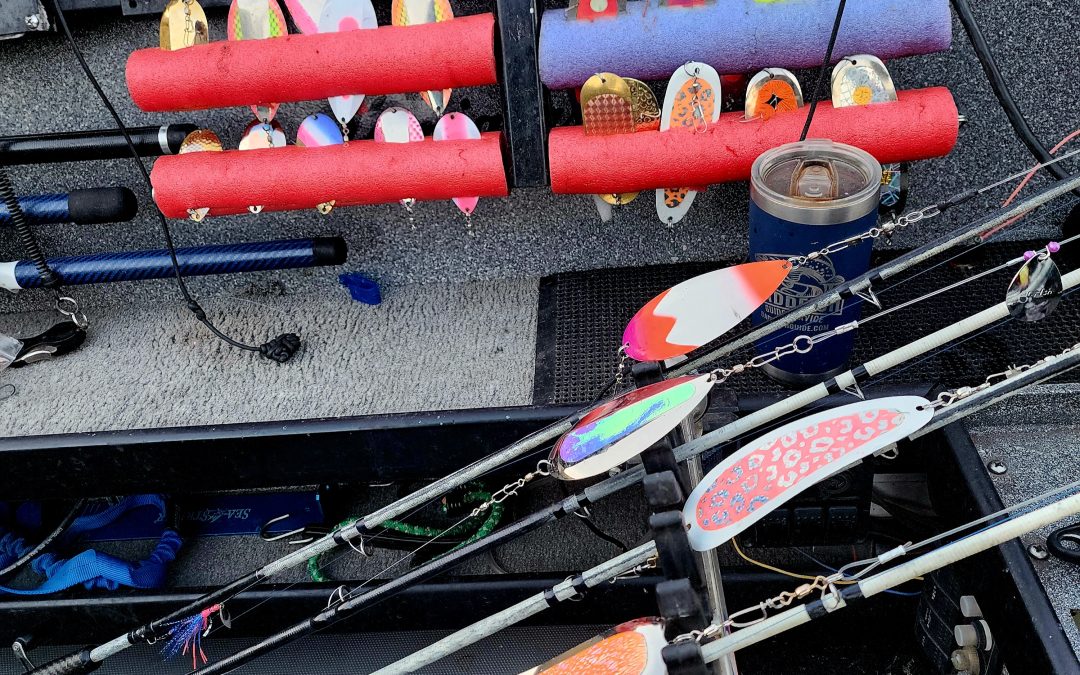
Poulsen Cascade Tackle Arrow Flash Dodgers
Small hoochies
Depending on water clarity and fish activity, presentations may be run anywhere from 30 feet to over 100 feet behind the boat.
Typical Long Line Setup Used at Baddfish Guide Service
A standard long line setup that we commonly use at Baddfish Guide Service starts with:
15-pound main line
Connected to a VIP Mini Line Lock Slider
Above a 6-bead chain swivel
Followed by a 30-inch bumper using 50–100-pound line
Connected to your dodger
From there, the “business end” of the setup consists of:
A kokanee spinner
Hoochie
Hawken Simon Hot Tail
Or your preferred kokanee lure
Most presentations are tipped with shoepeg corn to add scent, color, and additional appeal.
This setup creates excellent action while helping reduce line twist and maintaining proper dodger movement. The heavier bumper section between the dodger and mainline helps absorb shock from aggressive kokanee strikes while also adding additional action to the dodger itself.
Another big advantage of the heavier bumper material is that it makes tangles much easier to deal with. Kokanee fishing can sometimes create twisted messes when fish roll or multiple rods cross during a hot bite, and the stiff heavy bumper line helps prevent severe tangles and makes untangling gear much faster and easier.
Using Sinker Weights to Cover Multiple Depths
One of the best advantages of long line fishing is the ability to stagger different sinker weights throughout the boat to efficiently cover multiple depths at the same time.
At Baddfish Guide Service, we commonly run:
Heavier weights toward the front of the boat
Lighter weights toward the back of the boat
This setup helps prevent tangles during turns while also allowing anglers to search different parts of the water column until productive depths are located.
A common setup may look like this:
Front of the Boat
5 oz sinker weight
Approximately 30 feet behind the boat
Targets deeper fish
Middle of the Boat
4 oz sinker weight
Approximately 45 feet behind the boat
Covers mid-depth fish
Back of the Boat
3 oz sinker weight
Approximately 55+ feet behind the boat
Targets shallower fish with a stealthier presentation
We typically separate presentations by roughly 10–15 feet in depth increments to avoid tangles and maximize coverage.
This system is extremely effective on Central Oregon lakes because kokanee are constantly moving throughout the water column, depending on:
Light conditions
Water temperature
Plankton movement
Boat traffic
Time of day
By staggering depths, anglers can quickly identify where the active fish are holding and adjust the rest of the rods accordingly.
Advantages of Long Line Fishing
1. Stealth and Natural Presentation
One of the biggest advantages of long lining is stealth.
Many Central Oregon lakes have extremely clear water, especially places like Paulina, Odell, and Crescent Lake. Kokanee can become boat shy during calm conditions or heavy boat traffic.
Running your gear farther behind the boat gives fish time to react naturally to your presentation without being spooked by engine noise, sonar pings, or boat shadows.
On tough bite days, this can make a major difference.
2. Excellent for Shallow Fish
Early in the season, kokanee are often feeding near the surface where water temperatures are cooler, and plankton concentrations are highest.
Long lining shines when fish are suspended in the top 10–25 feet of water.
This is common in spring on many Central Oregon lakes, especially during low-light mornings.
3. Simple and Affordable
Long lining is a simple and effective way to target kokanee without investing in expensive equipment.
You don’t need downriggers or advanced electronics to catch fish consistently.
This makes long lining a great option for:
Beginner anglers
Families
Small boats
Kayak anglers
Casual weekend fishermen
4. Great Lure Action
Without the tension of a downrigger release clip, many dodgers and kokanee lures develop a freer, more natural action.
Light dodgers like the Poulsen Cascade Tackle Arrow Flash Jr Dodgers work exceptionally well when long-lined because they maintain a smooth rolling action at slower trolling speeds.
Cons of Long Line Fishing
1. Less Precise Depth Control
The biggest disadvantage of long lining is estimating the exact depth.
Variables such as trolling speed, line type, lure resistance, and added weight all affect how deep your presentation runs.
When kokanee are tightly grouped at very specific depths, long lining can become less efficient.
2. Longer Fight and Reset Times
Because so much line is out behind the boat, it takes longer to reel fish in and reset rods.
While this can add excitement to the fight, it may also lead to more lost fish due to kokanee’s soft mouths.
3. Increased Tangle Potential
Multiple long lines behind the boat can create tangles during turns or when fish cross lines.
Boat control becomes especially important when fishing with several anglers.
What Is Downrigger Fishing?
Downriggers allow anglers to place their kokanee presentations at exact depths using heavy cannonballs and release clips.
This method becomes extremely effective as water temperatures rise and kokanee move deeper in the water column during summer.
Many serious kokanee anglers on Central Oregon lakes rely heavily on downriggers once fish settle deeper.
Advantages of Downrigger Fishing
1. Precise Depth Control
This is the biggest advantage of downriggers.
If kokanee are holding at 47 feet, you can place your lure exactly at 47 feet every pass.
Modern sonar and fish finders make this incredibly effective because anglers can target suspended schools with pinpoint accuracy.
This becomes critical during the summer when fish may hold deep for most of the day.
2. Quick Depth Adjustments
Fish move constantly throughout the day based on light conditions, weather, and water temperature.
With downriggers, changing depths is quick and easy.
Instead of changing weights or guessing lure depth, you simply raise or lower the cannonball to stay on fish.
3. Cleaner Rod Spread
Downriggers help organize multiple rods efficiently without excessive amounts of line trailing behind the boat.
This reduces tangles and allows anglers to cover multiple depths at once.
For guide boats and larger groups, this is a huge advantage.
4. Best for Deep Summer Kokanee
As summer progresses, kokanee on lakes like Wickiup, Odell, and Crescent often move deeper into cooler water.
Fish may suspend anywhere from 40–80 feet deep or more depending on conditions.
Downriggers become incredibly valuable in these situations.
Trying to consistently target deep kokanee without downriggers can be difficult and frustrating.
Final Thoughts
Central Oregon offers incredible kokanee fishing opportunities, and understanding both long-line fishing and downrigger fishing will make you a more versatile and successful angler.
Long lining provides stealth, simplicity, and excellent shallow-water performance. Downriggers offer unmatched precision and deep-water control.
Both techniques catch fish consistently when used correctly.
If you’d like to learn these methods firsthand and experience some of the best kokanee fishing Oregon has to offer, book a guided trip with Baddfish Guide Service
For Lake Billy Chinook trips, visit Baddfish.com.
For Deschutes National Forest lakes, including Paulina, Odell, Wickiup, Crane Prairie, and Crescent Lake, visit Dayoneoutdoors.com and ask for James.
***Day One Outdoors Operates Under a Special Use Permit From The Deschutes National Forest***
Tight lines, and we’ll see you on the water
Recent Comments